
Upshot
Employee Stock Ownership Plans (ESOPs) offer a proven alternative to firm closure and/or capital outflow in rural areas by providing owners with a viable path to exit while keeping businesses operating locally.
In rural America, low succession planning rates, an aging owner base, and thin markets for sales create conditions where a significant number of closely held firms are at risk of closing due to business succession.
Introduction
A record number of U.S. business owners are approaching retirement without a clear succession plan. These challenges are especially acute in rural areas of the country, where older owners, older firms, and a limited pool of buyers can make ownership transitions harder and business closures more likely. Most small businesses never find a buyer, which can lead to firm closure, job losses, and disappearance of essential services. These consequences fall disproportionately on rural communities.
The scale of the challenge in rural America is significant. With 56% of rural business owners aged 55 or older — and 27% over 65 years old — rural communities have a higher concentration of aging ownership than urban markets. Firm age compounds this trend: 36% of rural businesses are over 21 years old, compared to 28% in urban areas. Together, an estimated 600,000 rural businesses have an owner today who is likely considering retirement. In manufacturing and other sectors designated as critical to national and economic security — which account for over a fourth of all rural companies — continuity of ownership is particularly significant to sustaining both rural economies and resilient supply chains.
Employee Stock Ownership Plans (ESOPs) offer a proven alternative to firm closure and/or capital outflow in rural areas by providing owners with a viable path to exit while keeping businesses operating locally. Numerous rural ESOP companies, whose employee stock ownership plans are worth nearly $77 billion and support more than 400,000 employees, demonstrate the existing ESOP footprint in rural America. Evidence shows that ESOP companies, particularly in manufacturing, are more resilient, more productive, and better positioned to preserve jobs and build worker wealth, making ESOPs a practical tool for strengthening rural economies.
Business Succession Planning
Few rural business owners have a succession plan, and most who exit without one close down their business.
In rural communities, the succession challenge is especially pronounced: buyers are scarcer, customer bases are smaller, and the consequences of closure are more severe.1 Surveys show that only around 30% of business owners have a robust, documented succession plan in place.2 When asked about their plans for the next five years, 10% of U.S. business owners that have employees say they are either unsure or plan on closing the business.3 These trends pose a serious threat to the small and medium-sized businesses that comprise the backbone of the American industrial base and anchor the economic vitality of rural areas.
The vast majority of small businesses close when an owner exits, and those who go to market often can’t find a suitable buyer.
It is estimated that only 20–30% of small and medium-sized businesses that go to market find a buyer.4 Many other owners never put their business up for sale at all, and simply close down. In some cases this is a genuine wind-down of a business at the end of its life, but in many others owners are simply unaware of the exit options available to them or lack access to the capital needed to finance a sale.5 Between the low sale rate and the owners who never make it to market, more than 90% of business exits end in closure rather than a sale.6 In rural areas, it can be even harder to sell a business due to factors like small customer bases and a thinner pool of potential buyers.7 These factors present significant negative implications for local economies that rely upon these mature businesses as sources of employment and investment within the regional economy.
20–30%
of small businesses that go to market are successful in finding a buyer4
Rural business closures carry outsized economic and social costs.
A single business closure can have significant adverse impacts on a rural community — both in terms of employment and access to essential services. Many small towns rely on just a handful of anchor employers, so the loss of these businesses can shake the economic foundation of the wider community. When a business closes, residents may also be forced to travel long distances to access the same goods or services elsewhere, compounding the economic and social loss to the region. Rural business owners know this and show an even higher concern for keeping the business in their community than owners in urban areas.8
Preserving existing rural businesses should be treated with the same urgency as new capital formation.
While significant policy attention is appropriately paid to supporting entrepreneurship and capital formation in rural areas, policymakers must be equally vigilant about preserving the mature businesses that anchor rural economies. Many businesses at risk of closure are productive, long-established firms providing stable employment, essential services, and community roots that new ventures cannot quickly replicate. Supporting viable ownership transitions and preventing capital flight is at least as impactful as new business creation.9 Both are absolutely essential to building a thriving, well-capitalized rural America.
The Silver Tsunami
Firms in rural areas also tend to be older, signaling a more acute volume of ownership transition and potential disruption of rural economies.
A record number of businesses have owners who are approaching retirement age, a phenomenon called the silver tsunami.10 While 53% of U.S. business owners are aged 55 or older, rural owners skew even older: 56% are over 55, and 27% are over 65, heightening the risk of business closures and job loss in rural areas.11 Firm age data matches these trends: In rural areas 36% of businesses are over 21 years old, compared to just 28% of urban businesses.12
This means that around 600,000 rural businesses have an owner who is likely thinking about retirement and exiting their business.13 Policymakers must confront this reality proactively in order to preserve economic vitality in rural America.
Figure 1
Business Owner Age Demographics
600,000
rural business owners are likely to retire in the next 10 years
Approximately 30,000 rural manufacturing businesses are likely to change ownership in the next ten years.
Many of these businesses are at risk of closing down, oftentimes lacking interested buyers who commit to long-term stability and domestic production.14 This challenge is particularly salient, as manufacturing businesses tend to have older owners — 63% are over the age of 55 — and account for a larger share of rural business establishments than urban ones (5% versus 3%).15
Roughly 150,000 rural business establishments that operate in sectors designated as critical to economic and national security by various U.S. agencies are likely to be sold in the next ten years.
Several federal agencies have identified industries with particular strategic significance, spanning sectors such as information technology, manufacturing, transportation, and logistics. According to the Department of Commerce and Department of War, 26% of all rural companies are operating in a critical sector.16 Examples of common rural firms defined as critical are metal stamping shops, specialized machine tool producers, crop farming operations, and coal mines.
This succession wave poses a direct threat to the vitality of American manufacturing and other rural sectors functioning as the backbone of industrial production.
Employee Stock Ownership Plans
ESOPs are a proven solution for keeping rural businesses running — strengthening the American industrial base and bolstering rural communities.
Definition
Employee Stock Ownership Plan (ESOP)
An ESOP is a tax-advantaged retirement plan that helps employees build ownership in the company where they work. The company contributes shares into an ESOP trust, and employees earn shares over time — at no cost to them. For retiring owners, an ESOP can be a flexible way to sell some or all of the business and transition leadership while keeping the company operating.
Figure 2
How an ESOP Works
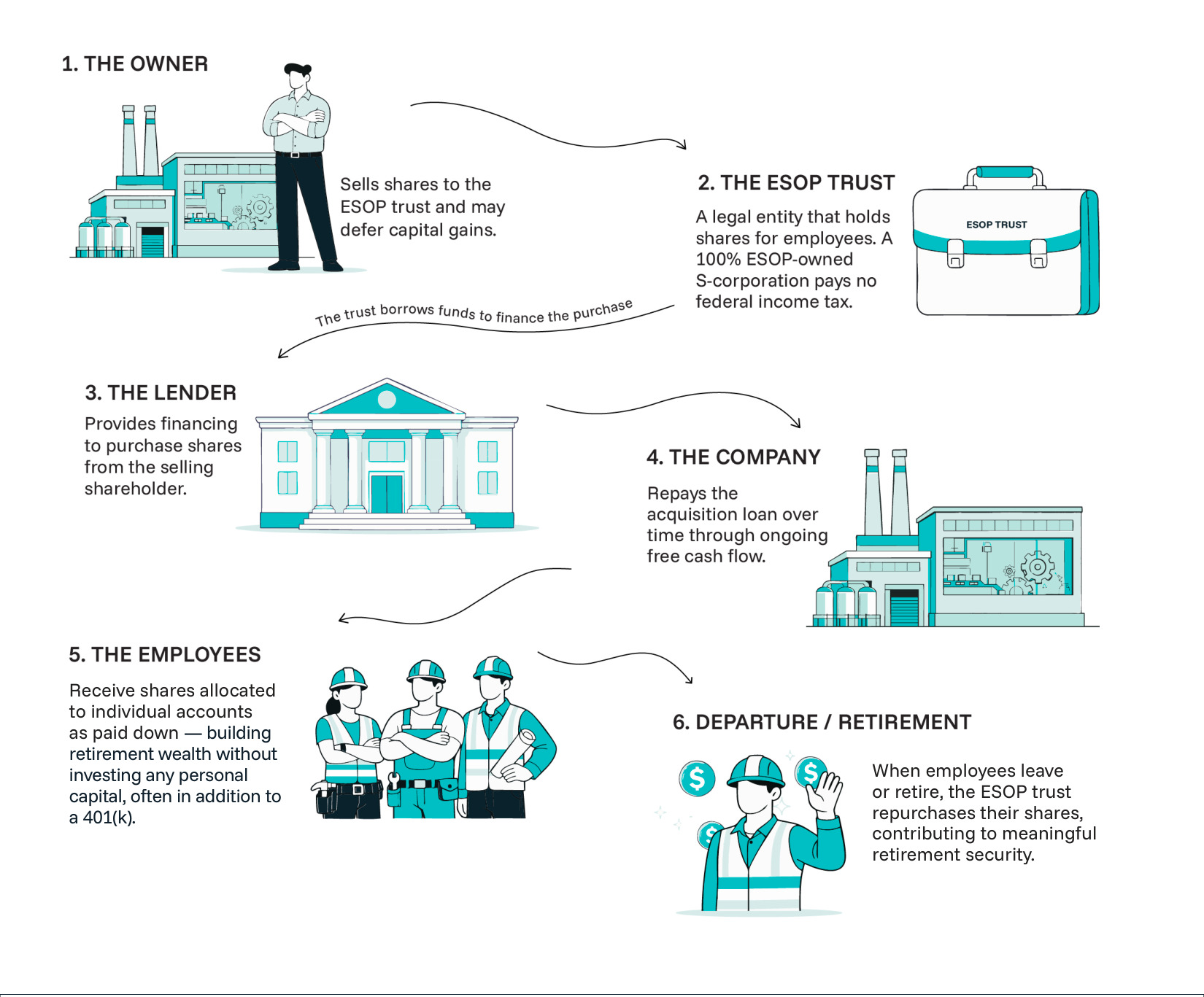
ESOPs help keep businesses operating, especially in rural and industrial communities.
Selling a business to an ESOP gives retiring business owners a way to exit or retire while preserving local jobs that build retirement security for the workforce. Rather than closing or selling to an outside buyer that may relocate or downsize operations, ESOP transitions allow firms to continue operating locally. This is particularly important in rural areas and in sectors like manufacturing, where a single closure or relocation can have outsized impacts on employment, service availability, and local supply chains.
ESOP companies tend to be more resilient and productive.
A growing body of research finds that ESOP-owned firms are more resilient than comparable non-ESOP firms. They are shown to grow faster, experience fewer layoffs during economic downturns, and are more likely to remain in operation over time.17 Recent evidence also suggests that ESOP-owned manufacturing firms have higher labor productivity than their peers, pointing to employee ownership as one potential response to the broader productivity slowdown in U.S. manufacturing.18
ESOPs build worker wealth and support high-quality jobs, aligning owner and worker interests.
Because ESOPs function as retirement plans, they allow workers to build meaningful wealth alongside their wages. The average account balance for employees at ESOP firms is more than double the average retirement account balance in comparable non-ESOP firms.19 On top of that, ESOP firms are more likely to offer a 401(k) retirement plan than the average firm.20 At the same time, owners gain an exit option that is often intrinsically preferable due to the ability to preserve the local legacy of the business and provide employees with an opportunity to participate in value creation. This is especially true in rural communities with limited alternatives.21
>2x
is the average ESOP account balance compared to retirement account balances at comparable non-ESOP firms19
ESOPs in Rural Areas
ESOP companies already have a strong rural presence and create substantial wealth and economic security for rural families.
Over 2,000 ESOP companies are located in census tracts defined as rural by the U.S. Census Bureau.22 All privately held rural ESOP companies combined have plan assets worth nearly $77 billion, and the average plan participant (current or former employee) holds over $140,000 in plan assets. This is around twice the median yearly household income in rural America.23 Throughout rural communities, over 400,000 people work for an ESOP company.24
One-fourth of all rural ESOP companies operate in manufacturing, and one-third operate in industries critical to economic and national security.
Manufacturing is one of the most prevalent ESOP sectors, and 19% of all privately held ESOP companies operate in the manufacturing sector, compared to 3-4% of all firms nationally. In rural areas, this representation is even stronger, with 24% of private ESOPs operating in the manufacturing sector.25
ESOPs support the stability and productivity needed for manufacturing firms to remain competitive. Adopting an ESOP is associated with a significant increase in labor productivity for manufacturing firms.26
Beyond manufacturing, another 11% of all rural ESOPs operate in other sectors designated as critical to economic and national security by various federal agencies.27 Overall, 35% of all rural ESOPs operate in a critical sector, 8 percentage points higher than the critical sector share of all U.S. firms.
Conclusion
In rural America, low succession planning rates, an aging owner base, and thin markets for sales create conditions where a significant number of closely held firms are at risk of closing due to business succession. Without proactive intervention, many viable businesses risk closing — not because they are unproductive or economically obsolete, but because owners lack realistic paths to transition ownership effectively.
ESOPs stand out as a solution that aligns the interests of owners, workers, and communities. They allow owners to preserve the legacy of their business, keep businesses locally rooted, protect jobs, and build generational wealth. The strong existing presence of ESOPs in rural and manufacturing communities, combined with evidence of improved resilience and productivity, suggests significant untapped potential.
Policymakers seeking to address the “silver tsunami” and sustain rural economies should view ESOPs as a core part of a broader strategy for rural economic vitality and resilience. At the federal level, there are several financing policy solutions that would make ESOP sales more viable. These include the bipartisan American Ownership and Resilience Act (AORA) — which would expand access to capital for employee ownership transitions — and regulatory action to reduce barriers to ESOP financing within the Small Business Administration’s 7(a) lending program. Together, these policies would give business owners, lenders, and communities the infrastructure they need to make employee ownership transitions viable at scale before the opportunity to preserve these businesses is lost.
Sources
- Yearwood, K., Stewart III, S., Marks, N., & Noel, N. (2026, February 26). The Great Ownership Transfer: A new era of business stewardship. McKinsey Institute for Economic Mobility. https://www.mckinsey.com/institute-for-economic-mobility/our-insights/the-great-ownershiptransfer-a-new-era-of-business-stewardship
- U.S. Bank. (2025). The small business perspective: Leading through change, shaping a legacy. https://www.usbank.com/content/dam/usbank/en/documents/pdfs/about-us-bank/leading-through-change-shaping-a-legacy.pdf PwC. (2023). PwC US family business survey 2023. https://www.pwc.com/us/en/services/trust-solutions/private-company-services/assets/pwc-family-business-survey-2023.pdf
- Gallup. (2025, March 25). Most Small-Business Owners Lack a Succession Plan. https://news.gallup.com/poll/657362/small-business-owners-lack-succession-plan.aspx
- Orosz, J. (2025). What Percentage of Businesses Sell? Morgan & Westfield. https://morganandwestfield.com/knowledge/what-percentage-of-businesses-sell/
- Biery, M. E. (2017, February 5). These 8 Stats Show Why Many Business Owners Can’t Sell When They Want To. Forbes. https://www.forbes.com/sites/sageworks/2017/02/05/these-8-stats-show-why-many-business-owners-cant-sell-when-they-want-to
- See 1
- Beach, B. (2024, July 1). Silver tsunami: Rural America small business owners retire. KCUR. NPR in Kansas City. https://www.kcur.org/news/2024-07-01/silver-tsunami-rural-america-small-business-owners-retire
- Darger, M., Petel, A., Macht, C., Hebeisen, J., Reed, C., & Dragotta, J. (2024, March). What new University of Minnesota Extension research reveals about business owners’ plans for the future transition of their firms. University of Minnesota Extension. https://mn.gov/deed/newscenter/publications/trends/march-2024/transition.jsp
- Templin, E., Chazdon, S., Muske, G., Barroso, F. D., Osborne, L., & Craig, W. (2017). The silver tsunami and rural small business retention: What can communities do? Community Development, 48(2), 282–298. https://brei.org/wp-content/uploads/2024/05/templin-chazdon-muske-barroso-osborne-craig-the-silver-tsunami-and-rural-small-business-retention.pdf
- Olin Brookings Commission. (2024). Scaling up to meet the challenge: The evolving landscape of small business transitions and ownership succession. Olin Business School & Brookings Institution. https://olin.washu.edu/docs/research/olin-brookings-commission-2024-policy-paper.pdf
- Federal Reserve Banks. (2025). 2025 Firms in Focus: Chartbook on Rural and Urban Firms. Fed Small Business. https://www.fedsmallbusiness.org/-/media/project/clevelandfedtenant/fsbsite/reports/2025/2025-firms-in-focus-chartbooks/sbcs_chartbook2025_ruralurban.pdf See 1
- Ibid.
- U.S. Census Bureau. (2025). Statistics of U.S. businesses (SUSB): 2022 annual tables. https://www.census.gov/data/tables/2022/econ/susb/2022-susb-annual.html, county table matched with National Center for Health Statistics. (2024). Urban–rural classification scheme for counties. Centers for Disease Control and Prevention. https://www.cdc.gov/nchs/data-analysis-tools/urban-rural.html, counting all business establishments in micropolitan or noncore counties, assuming a 52% rate of owners aged 55 or older as surveyed in U.S. Census Bureau. (2026). Annual Business Survey: Characteristics of business owners (AB2200CSCBO). data.census.gov. https://data.census.gov/table/ABSCBO2022.AB2200CSCBO?q=AB2200*&hidePreview=true&nkd=QDESC~O11
- Ibid, 30,000 and 150,000 figures calculated using NAICS codes 31-33 for manufacturing and NACIS code mix for critical industries specified in Moriarty, J. & Hohenberger, L. (2026). Manufacturing & Employee Ownership: How ESOPs Address the Threat of Business Succession in American Manufacturing. Lafayette Square Institute. https://www.lafayettesquareinstitute.org/wp-content/uploads/sites/386/ManufacturingEmployeeOwnership_Brief_LSI.pdf
- See 12, broken out for manufacturing business establishments.
- See 12, matched with our methodology for identifying critical businesses detailed here Lafayette Square Institute. (2025). Critical industries & employee ownership: Assessing the risks of business succession to U.S. national and economic security. Lafayette Square Institute. https://www.lafayettesquareinstitute.org/wp-content/uploads/sites/386/Critical-Industries-Employee-Ownership_LSI.pdf
- National Center for Employee Ownership. (2026). Research findings on employee ownership. NCEO. https://www.nceo.org/research/research-findings-on-employee-ownership
- Kurtulus, F. A., Hoyt, E., Ouimet, P., Blasi, J., Kruse, D., Freeman, R. B., & Castellano, W. (2026, March 29). Employee share ownership, management practices, and labor productivity: An analysis using establishment level micro-data from the U.S. Census. SSRN. https://ssrn.com/abstract=6490798 Lashkari, D., & Pearce, J. (2024, July 11). The mysterious slowdown in U.S. manufacturing productivity. Federal Reserve Bank of New York https://libertystreeteconomics.newyorkfed.org/2024/07/the-mysterious-slowdown-in-u-s-manufacturing-productivity
- National Center for Employee Ownership. (2025). The Retirement Savings Crisis and the Role of ESOPs. NCEO. https://www.nceo.org/research/the-retirement-savings-crisis-and-the-role-of-esops National Center for Employee Ownership. (2021). Measuring the Impact of Ownership Structure on Resiliency in Crisis. Employee-Owned S Corporations of America (ESCA). https://www.nceo.org/hubfs/ESCA%20Report.final.pdf
- The ESOP Association. (2026). ESOPs and retirement wealth inequality. The ESOP Association. https://www.esopassociation.org/articles/esops-and-retirement-wealth-inequality National Center for Employee Ownership. (2021). Measuring the impact of ownership structure on resiliency in crisis. Employee-Owned S Corporations of America (ESCA). https://esca.us/wp-content/uploads/2022/01/ESCA-Report-FINAL.pdf
- Olin Business School & Brookings Institution. (2023). The tidal wave of transitions on Main Street: Policy Paper 40. Washington University in St. Louis. https://olin.wustl.edu/_assets/docs/research/OlinBrookingsCommission2023-PolicyPaper40.pdf
- National Center for Employee Ownership. (2024). National ESOP Database - 2025 (2023 data, purchased), https://www.nceo.org/research/data/national-esop-database, on 2020 Census tracts and classified as rural using the U.S. Census Bureau’s 2020 Census Demographic and Housing Characteristics File, tables P2 and H2; a tract is treated as rural where it contains rural population or rural housing units. U.S. Census Bureau. (2023). 2020 Census Demographic and Housing Characteristics File. https://data.census.gov
- Ibid. Average assets per participant equals total plan assets divided by total plan participants across privately held rural ESOP companies. Median rural household income from U.S. Census Bureau, ACS 5-Year, 2024, table B19013, rural tracts per note 21.
- Ibid. Employment reflects total active plan participants across privately held ESOP companies in rural census tracts.
- Ibid. Broken out for manufacturing business establishments.
- Kurtulus, F. A., Hoyt, E., Ouimet, P., Blasi, J., Kruse, D., Freeman, R. B., & Castellano, W. (2026, March 29). Employee share ownership, management practices, and labor productivity: An analysis using establishment level micro-data from the U.S. Census. SSRN. https://ssrn.com/abstract=6490798
- National Center for Employee Ownership. (2024). National ESOP Database - 2025 (2023 data, purchased), https://www.nceo.org/research/data/national-esop-database and U.S. Census Bureau. (2025). Statistics of U.S. businesses (SUSB): 2022 annual tables. U.S. Department of Commerce. https://www.census.gov/data/tables/2022/econ/susb/2022-susb-annual.html matched with our methodology for identifying critical businesses detailed here Lafayette Square Institute. (2025). Critical industries & employee ownership: Assessing the risks of business succession to U.S. national and economic security. Lafayette Square Institute. https://www.lafayettesquareinstitute.org/wp-content/uploads/sites/386/Critical-Industries-Employee-Ownership_LSI.pdf
Cite this paper
Hohenberger, L. (2026, July). Rural Business Succession: The Role of Employee Ownership. Lafayette Square Institute. https://www.lafayettesquareinstitute.org/research/employee-ownership/rural-business-succession/
Hohenberger, Laura. Rural Business Succession: The Role of Employee Ownership. Washington, DC: Lafayette Square Institute, 2026. https://www.lafayettesquareinstitute.org/research/employee-ownership/rural-business-succession/.