

Upshot
Policymakers can confront the threat of the silver tsunami to our manufacturing base by creating conditions for Employee Stock Ownership Plan (ESOPs) to become a more viable option for business succession.
Business succession presents a clear risk to our industrial base, but we can turn those risks into opportunities by creating favorable conditions for the growth of employee ownership.
The demographics of business succession pose a serious risk to the strength and productive capacity of the U.S. manufacturing base.
Baby boomers make up the largest group of business owners in the country.1 As this generation reaches retirement age—a phenomenon known as the “silver tsunami”—a record number of privately held businesses are facing a change of ownership in the next five years.2 Too often, exiting business owners either 1) close the business for lack of an interested buyer or family successor or 2) have little choice but to sell to a competitor or offshore buyer that may not be committed to keeping jobs and production in the United States.3
Definition
Silver Tsunami
The demographic phenomenon of a record number of business owners preparing to exit their businesses. It poses significant retention risk to the American industrial base if those businesses close or sell to buyers not committed to domestic employment and production.
In the manufacturing sector, the silver tsunami is especially acute, with more business owners approaching retirement age than the U.S. firm average.4 Nearly two thirds of all manufacturing businesses have an owner that is aged 55 or older and nearly a third have a business owner that is 65 or older. This means that the majority of American manufacturing businesses are likely to experience an ownership transfer in the next five to ten years. At a conservative estimate, this translates to about 150,000 American manufacturing companies (comprising approximately 180,000 unique establishments) that could be at risk of closure or offshoring.5 Policymakers can confront the threat of the silver tsunami to our manufacturing base by creating conditions for Employee Stock Ownership Plan (ESOPs) to become a more viable option for business succession.
63%
of all manufacturing businesses have owners aged 55 or older.
150,000
U.S manufacturing firms are likely to undergo near-term business succession
What is an ESOP?
The ESOP is a proven succession alternative to closure or offshoring. It is both a financing vehicle and a tax-advantaged retirement plan that helps employees build ownership in the company where they work. The company contributes shares into an ESOP trust, and employees earn shares over time—at no cost to them. For owners, an ESOP can be a flexible way to sell some or all of the business and transition leadership while keeping the company operating.
Figure 1
How an ESOP Works
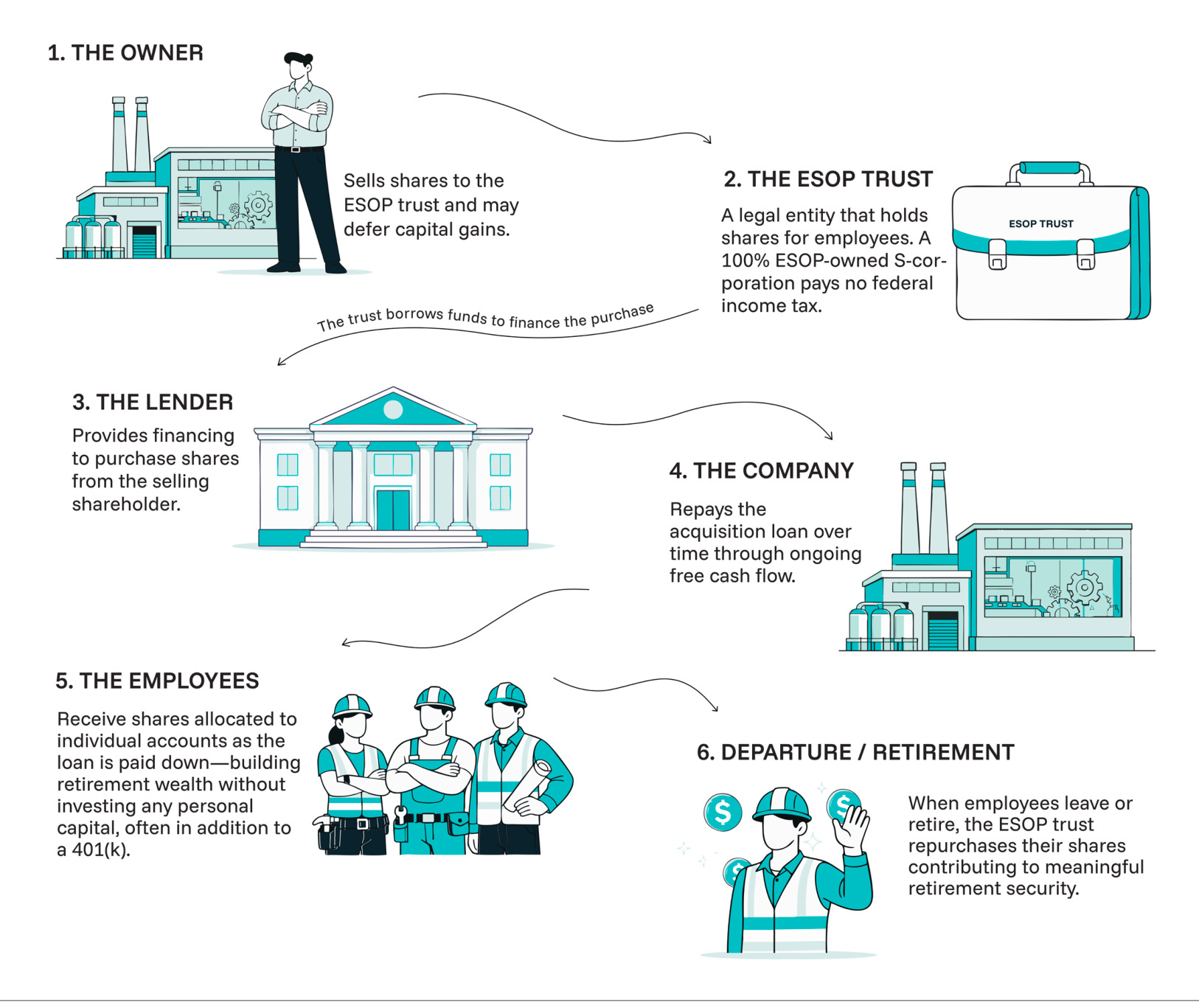
Employee Stock Ownership Plans (ESOPs) are an alternative to closure or offshoring.
Selling a closely held manufacturing business to an ESOP is an opportunity to preserve domestic production while building retirement wealth for American workers. ESOP companies are shown to be more resilient, grow faster and lay off less workers during economic downturns than competitors.6 Recent evidence suggests further that ESOP-owned manufacturing firms boast higher labor productivity than their peers, making the growth of ESOPs part of a broader strategy to address productivity challenges in the U.S. manufacturing sector.7
ESOPs have a strong track record of success in the manufacturing sector.
There are more ESOP companies in the manufacturing sector than in any other industry.8 While less than 4% of all U.S. firms operate in the manufacturing sector, manufacturers represent over 20% of all ESOPs nationwide.9 Manufacturing’s capital-intensive production and long investment horizons make the sector particularly well suited to employee ownership, as ESOPs encourage reinvestment and operational continuity. By strengthening worker retention in skilled roles where training costs are high, ESOPs support the stability and productivity needed for manufacturing firms to remain competitive.
20%
of all ESOPs nationwide are in manufacturing.
Employee ownership can help convert the wave of retiring manufacturing owners into a competitive advantage.
Business succession presents a clear risk to our industrial base, but we can turn those risks into opportunities by creating favorable conditions for the growth of employee ownership. ESOPs face both capital access and regulatory barriers that have impeded their growth, but addressing these issues offers an additional tool to prevent offshoring and the loss of U.S. productive capacity.
By reducing the financing and regulatory barriers that currently discourage the sale of U.S. businesses to their employees through an ESOP, policymakers have a bipartisan opportunity to enable U.S. manufacturers to retain their domestic footprint once those businesses are sold. With an imminent generational wave of business succession that is especially pronounced in the manufacturing sector, employee ownership is an increasingly important tool to strengthen our economic security including the retirement security of American workers and families. Reindustrializing America requires a proactive strategy to confront business succession — employee ownership is uniquely positioned to convert these risks into an enduring competitive advantage.
Sources
- U.S. Census Bureau. (2026). Annual Business Survey: Characteristics of business owners (AB2200CSCBO). data.census.gov. https://data.census.gov/table/ABSCBO2022AB2200CSCBO?q=AB2200*&hidePreview=true&nkd=QDESC~O11
- Wince-Smith, D. (2022, February 25). Bracing for the silver tsunami. Forbes. https://www.forbes.com/sites/deborahwincesmith/2022/02/25/bracing-for-the-silver-tsunami/
- Olin Business School & Brookings Institution. (2023). The tidal wave of transitions on Main Street: Policy Paper 40. Washington University in St. Louis. https://olin.wustl.edu/_assets/docs/research/OlinBrookingsCommission2023PolicyPaper40.pdf
- See source 1
- U.S. Census Bureau. (2022). Statistics of U.S. businesses (SUSB): 2022 data table by establishment industry (6-digit NAICS). U.S. Department of Commerce. https://www.census.gov/data/tables/2022/econ/susb/2022-susb-annual.html
- National Center for Employee Ownership. (2026). Research findings on employee ownership. NCEO. https://www.nceo.org/research/research-findings-on-employee-ownership
- Kurtulus, F. A., et al. (2025). Employee Share Ownership, Management Practices, and Firm Outcomes in U.S. Lashkari, D., & Pearce, J. (2024, July 11). The mysterious slowdown in U.S. manufacturing productivity. Federal Reserve Bank of New York https://libertystreeteconomics.newyorkfed.org/2024/07/the-mysterious-slowdown-in-u-s-manufacturing-productivity
- National Center of Employee Ownership. (2024). National ESOP Database – 2025 (2023 data, purchased). NCEO. https://www.nceo.org/research/data/national-esop-database
- See sources 5 and 8
Cite this paper
Moriarty, J., & Hohenberger, L. (2026, February). Manufacturing and Employee Ownership: How ESOPs Address the Threat of Business Succession in American Manufacturing. Lafayette Square Institute. https://www.lafayettesquareinstitute.org/research/employee-ownership/manufacturing/
Moriarty, Jack, and Laura Hohenberger. Manufacturing and Employee Ownership: How ESOPs Address the Threat of Business Succession in American Manufacturing. Washington, DC: Lafayette Square Institute, 2026. https://www.lafayettesquareinstitute.org/research/employee-ownership/manufacturing/.