Personnel is Industrial PolicyRebuilding state capacity for a working-class America
The federal government cannot execute an ambitious industrial policy without the people to run it. This paper lays out a full taxonomy of federal hiring authorities, documents the capacity gaps across Treasury, Commerce, DOE, and other agencies, and proposes a pathway to the sustained, mission-driven federal workforce needed to deliver on working-class policy commitments.

Executive Summary
Industrial policy succeeds or fails based in part on the federal government's ability to hire and retain specialized human capital. Various government offices increasingly depend on world-class technical, scientific, and financial expertise to execute their missions. In practice, attracting such experts has proven challenging under the standard hiring conditions dictated by the Title 5 civil service framework. That framework, which works well to safeguard merit, uniform standards, and insulation from political interference across the federal workforce, also locks in slow, rule-bound hiring processes that are often poorly suited for the pace of industrial policy.
Consider the Defense Advanced Research Projects Agency (DARPA)—the engine of the Pentagon's innovation ecosystem since the late 1950s—which has long recruited world-class program managers and technical leaders from industry and academia, often for term-limited tours. DARPA has been able to recruit and retain skilled human capital precisely because it has a statutory exemption from much of Title 5, as recruiting talent with speed and competitive compensation remains a constant challenge under the existing civil service framework. Likewise, the Department of Defense's Office of Strategic Capital (OSC), established in 2022 to mobilize private investment toward critical and emerging technologies, now holds responsibility for over $200 billion in loan authority—an increase of $199.1 billion from its previous authority.1 To administer such capacity effectively, OSC must staff its ranks with investment, risk, and program management specialists, which are difficult to source through traditional Title 5 hiring alone. In an era where policymakers on both sides of the aisle are turning to industrial policy to address profound economic and national security challenges, recruiting and retaining specialized talent has never been more important. This brief offers a primer to the hiring side of the equation, including an inventory of the existing "menu" of statutory hiring authorities. The purpose of this analysis is to inform future industrial policy design and help inform broader reform conversations related to federal hiring and enhancing state capacity more generally.
The Status Quo: Title 5
Title 5 federal civil service law often presents structural constraints that materially limit agencies' hiring capabilities. Notoriously cumbersome, the hiring process for new employees can take as long as 9 months from job posting to start date.2 Rigid classification and General Schedule (GS) pay scales limit salaries and hiring flexibility, hampering the ability of many agencies to keep pace with the private sector on compensation, particularly for specialized talent and high-demand experts.3 The data underscore the consequences of this rigidity: in the 2022 and 2023 fiscal years, nearly one-third of competitive federal job postings closed with no hire.4 This pattern reflects a basic problem observed by Jen Pahlka of the Niskanen Center: too often, the candidates who reach hiring managers fail to meet the specific skills the job requires.5 With this skills mismatch all too common, the limitations of Title 5, however well-intentioned, risk becoming a serious bottleneck when modern industrial policy demands cutting-edge expertise on tight timelines.
For decades, federal agencies have made efforts to address these talent bottlenecks by turning to special hiring authorities that fall outside the usual Title 5 competitive service rules.6 These authorities—including Schedule A excepted service, direct hire authority, and the Intergovernmental Personnel Act—allow agencies to both expedite hiring and offer more competitive terms for specialized talent. Such authorities can also be found at the heart of the workforce strategies of recent American industrial policy initiatives, including the CHIPS and Science Act and ARPA-E.
This policy brief takes stock of the federal hiring authorities that have been leveraged in service of U.S. industrial policy and innovation programs by cataloging the array of special hiring authorities and organizing them into a taxonomy intended for policy design. In the sections that follow, we examine how and why agencies have deployed these tools in practice (with examples from the Office of Strategic Capital, DARPA, CHIPS Program Office, and the Federal Reserve Board of Governors) to overcome staffing hurdles. By consolidating these authorities and situating them in the context of modern industrial policy design, the brief aims to inform policymakers and related stakeholders about the personnel levers available when designing and implementing ambitious technology, financial, and industrial policies designed to advance the national interest.
Taking Stock: A Brief Taxonomy of Hiring Authorities
Recent state capacity work by Jennifer Pahlka, the Niskanen Center, and others argues that the federal hiring system's defaults (i.e., Title 5 competitive examination, GS classification, and a process-obsessed compliance system) produce slow time-to-hire and weak skill signals for technical, financial, and digital roles.7 In this account, agencies rely too heavily on résumé self-attestations and generic rating and ranking of candidates, use predictive assessments too sparingly, and route decisions through fragmented HR and legal processes.8 The result is a process defined by too many postings that close unfilled and too few candidates possessing the requisite skills. These experts contend that the fix is not more ad-hoc waivers, but a shift to a well-defined system of skills-based hiring, modern assessment, and clear accountability for talent outcomes as part of a broader state capacity agenda.9
Statutory and regulatory overlays and legacy HR systems compound this problem, such that even when agencies obtain the special authorities discussed herein, staffing yield still stalls if assessment and delivery capabilities are weak.10 The throughline of the state capacity literature is pragmatic: special federal hiring authorities can buy speed and flexibility, but durable performance requires systemic reform so that the civil service hiring process reliably and routinely surfaces qualified finalists and closes hires on time.11 This brief accepts much of this account from the state capacity literature and, in this section, turns to the specific chokepoints that federal hiring authorities are designed to address.
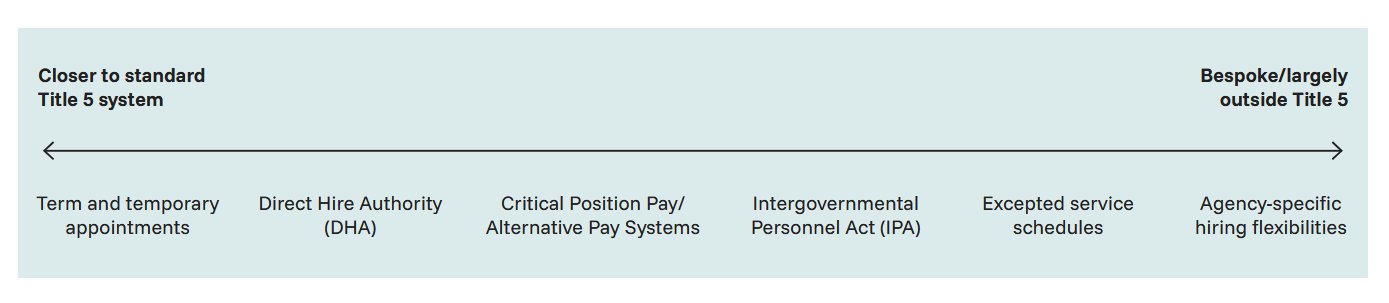
The levers used to recruit and hire specialized talent outside of the Title 5 process vary significantly from agency to agency. This section introduces the landscape of federal hiring authorities that:
- Accelerate selection (Direct Hire Authority),
- Operate outside the competitive service (Excepted Service schedules),
- Adjust compensation and pay (critical pay and alternative pay systems),
- Time-limit service to match project needs (term and temporary appointments),
- Enable short-term outside expertise (IPA mobility), and
- Are bespoke to particular missions (agency-specific systems).
For each, we discuss the specific bottleneck the tool is designed to address and where the authority sits, along with key tradeoffs in speed, oversight, and durability.
Direct Hire Authority (DHA)
Direct Hire Authority (DHA) allows federal agencies to fill critical vacancies quickly when a "critical hiring need or severe shortages of candidates" exists.12 Created in 2002 when Congress sought to address hiring bottlenecks via the Chief Human Capital Officers Act of 2002 (Title XIII of the Homeland Security Act of 2002), DHA enables agencies to bypass certain competitive hiring procedures and bring qualified candidates on board faster.13 Under a DHA, agencies can hire into the competitive service "without regard to sections 3309 through 3318 of Title 5," which means they are not required to conduct formal ranking of candidates or apply veterans' preference points in selections. This streamlined authority is typically granted by the Office of Personnel Management (OPM) for specific occupations or groups, either government-wide or agency-specific, and remains in effect as long as the defined shortage or critical need persists. Agencies must still publicly announce the job and ensure selectees meet basic qualifications, but DHA removes the extra time and steps of traditional competitive exams and rating processes. The primary tradeoff with DHAs is a loss of some competitive hiring checks and preferences; consequently, DHA is used sparingly and mostly targeted to mission-critical talent needs.
Agency examples: The Department of Defense (DoD) uses DHA extensively to rapidly staff cybersecurity and engineering roles.14 DoD has obtained numerous DHA provisions via reauthorizations of the National Defense Authorization Act to expedite STEM hiring.15
Excepted Service Schedules
Excepted service hiring authorities allow agencies to fill certain positions outside the competitive civil-service process, meaning they are not filled through the standard open competitive examinations. Excepted service is a longstanding mechanism to provide flexibility for roles that have unique requirements or where competitive hiring is impractical. OPM defines several Schedules for excepted appointments, the main ones being Schedule A, B, and C. Schedule A covers categories of jobs that can be filled without competition, such as attorneys (whom OPM exempts from competitive hiring). Schedule B allows excepted appointments for positions for which OPM has determined the competitive exam process is not practical, often with the option to convert to competitive status later. Schedule C covers political appointments—confidential or policy-determining positions that are excepted from competitive hiring by nature (typically filled at the discretion of the administration). In all these cases, candidates can be appointed directly into the excepted role, and these appointments do not confer competitive status.
Importantly, excepted service agencies and positions define their own qualifications and are exempt from many Title 5 rules governing hiring, pay, and classification.16 These flexibilities notwithstanding, merit principles and certain protections (e.g., veterans' preference) often still apply to ensure fairness. Several entire agencies operate entirely (or almost entirely) in the excepted service under specific legal authority. These tend to be agencies with unique missions or security considerations. For example, almost all jobs in the intelligence community (CIA, NSA, etc.) and many at the Department of State are excepted service, allowing those organizations to use tailored hiring criteria and processes suited to their specialized needs.
Agency examples: Several Intelligence Community (IC) agencies, including the CIA, NSA, and FBI, hire their workforces almost entirely under excepted service authority due to mission needs. Across all agencies, Attorney positions are filled via Schedule A (excepted service) hiring. Additionally, programs like the Presidential Innovation Fellows use excepted service appointments to bring in talent for limited-duration fellowships, as did the former Presidential Management Fellowship.17
Critical Pay and Alternative Pay Systems
Critical Position Pay Authority (CPPA) is a special authority that allows agencies, with OPM approval, to offer salary beyond the normal General Schedule (GS) pay caps for especially critical positions. Established in 1990 (5 U.S.C. § 5377) to help recruit or retain exceptional talent, CPPA lets an agency set a higher basic pay for a critical position when the GS pay rates are insufficient to attract qualified candidates.18 This authority is rarely used; OPM can authorize up to 800 critical pay positions, but only a few dozen have ever been approved since 1990.19 The stringent approval process, which requires OPM and OMB sign off, and availability of other flexibilities often lead agencies to seek alternatives before considering CPPA. It still remains an important tool, however, for unique cases involving scientists, cybersecurity experts, and other specialists who command salaries above typical governmental limits.
Beyond individual pay-setting authorities, many agencies use alternative pay systems to enhance their recruitment and retention. These systems depart from the standard GS scale in favor of broader pay bands or different pay progression models. Alternative personnel systems often come as part of demonstration projects or agency-specific statutes. For example, Congress granted the Federal Aviation Administration (FAA) exemption from most of Title 5 in 1995, allowing FAA to create a new personnel management system with its own pay bands and hiring rules.20 Similarly, many DoD research laboratories and acquisition offices operate under pay banding demonstration projects instead of the GS, enabling more flexible starting salaries, merit-based raises, and streamlined hiring of professionals in high demand. The rationale behind these alternative pay systems is to give managers tools to attract and retain top talent in critical fields.
Agency examples: NASA and the Department of Energy have occasionally requested critical pay authority to bring in scientists for special projects.21 Department of Defense labs use demonstration pay band systems to attract and reward technical experts.22 Outside Title 5, the FAA and many financial agencies (such as the Federal Reserve, FDIC, and OCC) have independent pay and classification systems that allow higher salaries and flexible hiring to meet their unique talent needs.23
Term-Limited Appointments
Agencies occasionally rely on term-limited appointments to meet short-term or project-based talent needs. Term appointments are non-permanent and typically last between 1 and 4 years by default. These appointments, authorized under standard civil service regulations, are used when an agency has work of a temporary nature or is unsure if ongoing funding will continue. There are also temporary appointments, which are even shorter (usually not more than a year, often limited to 1 or 2 years with extensions) and used for transient needs or seasonal work. By using term or temporary hires, agencies gain the flexibility to staff up quickly for a defined period (e.g., to stand up a new function, execute a time-bound project, or surge staff for an emergency) without making long-term commitments beyond the project's life. Term-limited appointments are authorized by OPM regulations and generally do not require statutory authorization, though some agency-specific term-limited authorities do (e.g., Department of Defense's Highly Qualified Experts authority, described below).24
The federal government has recently used term-limited hiring strategically to leverage outside expertise. Tech-focused teams like the U.S. Digital Service (USDS) and the Presidential Innovation Fellows bring in private sector professionals for "tours of service" that last 2 to 4 years, leveraging term appointments to do so. This model gives the government access to up-to-date industry skills and new perspectives, while appealing to experts who may not want a permanent government career. The Department of Defense similarly has a Highly Qualified Experts (HQE) program to appoint distinguished professionals from industry or academia into Defense roles for up to 5 years. These experts on term appointments can advise on critical projects or lead innovative initiatives without a permanent tenure. In many cases, term appointees receive expedited hiring and higher pay-setting under special authority, reflecting the understanding that they are bringing scarce skills for a limited time.
Agency examples: The Department of Defense uses term-limited hiring for initiatives like bringing in Highly Qualified Experts (HQEs) on 3-5 year stints to rapidly stand-up new capabilities or mentor DoD teams.25 This is evident in the Department's approach to staffing the Office of Strategic Capital (OSC). OSC's founding director, Jason Rathje, served under a three-year Senior Executive Service limited term appointment, illustrating how term-limited leadership is often deployed to quickly establish new capabilities and then refresh.26 Additional examples include the Presidential Innovation Fellows program, which appoints fellows for one year, with an option to extend to two.27
Intergovernmental Personnel Act (IPA) Mobility
Another pathway for accessing outside talent is the Intergovernmental Personnel Act (IPA) Mobility Program. Congress created the IPA in 1970 to facilitate temporary assignments to or from the federal government and other institutions in a secondment capacity. Rather than creating agency-specific authorizations, the Intergovernmental Personnel Act of 1970 established a single framework that any agency can use.28 Under this framework, an employee from another organization (e.g., a university or nonprofit) can work at a federal agency for a limited period of up to 2 years (often extendable to 4 years), or a federal employee can go on loan to an outside organization under a formal agreement. The individual remains an employee of their home organization, but for the duration of the assignment, they work for the host institution, and costs (salary, travel, benefits, etc.) can be shared or reimbursed as negotiated. In practice, IPAs have been a valuable tool for science and technology agencies to bring in academic researchers or industry experts who can bring the latest research and insights from their fields into federal programs.
Agency examples: Science agencies such as the National Science Foundation (NSF) and Department of Energy laboratories extensively use IPA assignments to bring in university scholars for a few years. Both Trump administrations have used IPA agreements to staff scientific and technical roles. In Trump's first term, the NSF reported 174 staff on IPA appointments in 2017, for example.29 Trump's second term has similarly sought to leverage IPAs, explicitly directing agencies to rely on IPA agreements to bring designers and other experts into government in the Improving Our Nation Through Better Design executive order in August 2025.30 The Biden administration likewise used IPA agreements with several nonprofits, including Schmidt Futures, to staff technology policy teams at the White House and throughout the federal government.31
Agency-Specific Hiring Flexibilities
Some agencies have their own unique hiring authorities and personnel systems granted by Congress, giving them extra flexibility beyond standard civil service rules. These include the Federal Aviation Administration (FAA), Federal Reserve Board (FRB), the Federal Deposit Insurance Corporation (FDIC), and the Veterans Health Administration (VHA). In 1995, Congress explicitly exempted the FAA from most of Title 5's hiring and pay provisions, directing the agency to implement a new personnel system tailored to its needs, with the Department of Transportation and Related Agencies Appropriations Act of 1996.32 This reform arose because FAA faced chronic delays in hiring air traffic controllers and other specialists under the regular system. With its independent authority, FAA can set its own hiring procedures and pay scales, enabling faster recruitment of controllers and technical staff.
Other civilian agencies with special hiring flexibilities include certain federal financial regulators and independent entities. For instance, the Federal Reserve Board and agencies like the Federal Deposit Insurance Corporation (FDIC) are not under the General Schedule, and they have authority to establish their own compensation and recruitment policies. This independence, often provided by law in the agency's authorizing statutes, allows these organizations to offer compensation that is closer to private sector norms and to hire staff with niche skills without going through the traditional OPM process. Similarly, the Veterans Health Administration (VHA) in the Department of Veterans Affairs hires most of its physicians, nurses, and other health professionals under Title 38 of the U.S. Code, which gives VA direct hiring authority and flexible pay setting for medical personnel to better compete with the private healthcare market.33
| Federal Hiring Authority | Primary Bottleneck Addressed | How It Works | Example Use Cases |
|---|---|---|---|
| Direct Hire Authority (DHA)5 U.S.C. § 3304(b) | Slow time-to-hire and competitive-service bottlenecks for critical or shortage occupations. | OPM-approved authority to appoint qualified candidates without regard to the rating, ranking, and veterans' preference procedures in 5 U.S.C. §§ 3309–3318. | DoD cybersecurity and STEM hiring; CHIPS Program Office (Commerce/NIST) rapid staffing. |
| Excepted Service Schedules (A, B, C)5 U.S.C. § 3302; 5 C.F.R. pt. 6 | Entire categories of roles that are ill-suited to competitive examinations. | Positions filled outside the competitive service under Schedules A, B, or C, with tailored qualifications; merit principles still apply. | Attorneys (Schedule A); Intelligence Community agencies; Presidential Innovation Fellows. |
| Critical Pay and Alternative Pay Systems5 U.S.C. § 5377; agency-specific statutes | GS pay ceilings that sit below market for highly specialized scientific, financial, or technical talent. | OPM and OMB-approved pay above GS caps for designated critical positions; pay-banding demonstration projects in lieu of the GS. | NASA and DOE critical pay appointments; DoD science and technology labs; FAA personnel management system. |
| Term-Limited and Temporary Appointments5 C.F.R. pt. 316 | Time-bound, project-based, or surge staffing needs without permanent headcount. | Non-permanent appointments of one to four years (term) or shorter temporary appointments; often paired with expedited hiring authorities. | U.S. Digital Service; Presidential Innovation Fellows; DoD Highly Qualified Experts. |
| Intergovernmental Personnel Act (IPA) Mobility5 U.S.C. §§ 3371–3376 | Access to external scientific, academic, and state and local expertise without a permanent federal hire. | Temporary assignments of up to two years (extendable to four) between federal agencies and universities, nonprofits, tribal governments, or state and local governments. | NSF academic rotators; DOE national laboratories; White House science and technology staffing. |
| Agency-Specific Hiring Flexibilities10 U.S.C. § 149 (OSC); DARPA § 1101; 12 U.S.C. § 244 (FRB); 49 U.S.C. § 40122 (FAA); 38 U.S.C. § 7401 (VHA) | Mission-specific workforce constraints that government-wide tools cannot solve. | Bespoke, statutorily granted personnel systems operating largely or entirely outside Title 5, with agency-defined classification, pay, and hiring rules. | DARPA; DoD Office of Strategic Capital; Federal Reserve Board; FAA; VHA Title 38. |
Agency Use Cases of Federal Hiring Authorities
The federal hiring authorities discussed in the previous section generally serve three functions: improving hiring speed, competing with market compensation, and enhancing governance. This section presents how agencies generally approach each of these functions in deciding which hiring authorities to avail themselves.
Speed
Many industrial policy programs face urgent timelines that the standard hiring pipeline cannot meet. The federal hiring process is notoriously slow—taking about 101 days on average (more than twice as long as in the private sector) and often stretching much longer.34 Programs like the CHIPS Act incentives or DOE loan guarantees have firm deadlines for deploying funds, making such delays risky to these offices' core missions.35 To accelerate staffing, they leverage special hiring authorities (such as direct hire and excepted service appointments) that bypass many Title 5 hurdles and streamline recruitment. The CHIPS Program Office, for instance, used a combination of CHIPS Act direct-hire authority and Schedule A excepted service to quickly appoint qualified staff in support of the semiconductor program. By cutting out lengthy rating and ranking procedures, these authorities enable agencies to hire in weeks instead of months, ensuring critical initiatives were not held back by understaffing.
Market Competition
Agencies recognize that specialized technical and financial talent is in high demand and they must have a value proposition for candidates that is sufficient to attract private sector talent. Rigid GS pay scales and civil service hiring rules often make federal employment less attractive, with hiring managers routinely losing candidates because the federal government is unable to match industry salaries or offer flexible terms. Alternative hiring authorities help government recruiters level the playing field on compensation and job structure. These authorities may allow higher salary bands, project-based term appointments, and performance incentives beyond the usual GS limits. Congress explicitly recognized this need when establishing ARPA-E, granting it authority to hire outside standard pay grades at levels commensurate with private-sector salaries so it could attract "the highest talents available" in science and engineering. Similarly, many Defense and Energy Department excepted-service roles can be offered at pay rates (up to executive levels) with bonuses that are simply unattainable under Title 5's constraints.
Governance
Agencies often leverage some of these federal hiring authorities to build a managerial advantage by structuring roles in ways that promote innovation and accountability. A notable example is the term-limited program manager model used by DARPA and ARPA-E. Rather than hiring permanent staff, these organizations bring in experts on 2- to 5-year tours of duty. Program managers typically serve only a few years, which "fuel[s] a sense of urgency to deliver results quicker than virtually any other research setting."36 In practical terms, term appointments also mean agencies can more easily adjust or wind down programs after a project's conclusion, avoiding the inertia that sometimes plagues permanent bureaucracy. This governance rationale is why, for example, ARPA-model organizations insist on rotating staff: it keeps the focus on measurable outcomes, enables rapid pivots or portfolio refocusing, and equips the team with cutting edge expertise from industry or academia.
Case Studies
The federal hiring authorities discussed in this brief have been deployed for a range of policy objectives, including recent bursts of industrial policy initiatives and well-established innovation policy programs. Below we profile how these authorities have historically buoyed execution capacity through faster staffing, access to scarce expertise, and pay tools that attract top talent.
DoD Office of Strategic Capital (OSC)
The Department of Defense established the Office of Strategic Capital (OSC) in 2022 by memorandum of the Secretary of Defense to leverage private capital to bolster the defense industrial base in critical technology domains; it was later codified by Congress in the National Defense Authorization Act of 2024.37 OSC's mission, which involves managing novel investment programs like the Small Business Investment Company Critical Technology Initiative and direct lending capabilities, requires specialized financial and technological talent not typically found in DoD's civilian workforce. Recognizing this talent shortage, Congress explicitly equipped OSC with flexible hiring authorities similar to DARPA's in the FY2024 National Defense Authorization Act.38 Along with DARPA and other DoD programs, OSC can now formally run an excepted service talent program whereby it may hire up to 30 employees without regard to the Title 5 process. This enables the office to directly recruit investment bankers, venture capitalists, and technologists who otherwise may not consider government service.
Beyond recruitment and hiring flexibilities, OSC is equipped with authorities to offer salaries well beyond the standard GS scale, up to 150% of the Vice President's salary of $289,400 as a basic pay cap.39 This substantial compensation removes a major constraint that would otherwise inhibit OSC's ability to attract private sector talent. As with DARPA and similar agencies, OSC's appointments are term-limited to 4 years, with an optional 2-year extension. Though these authorities for OSC are relatively new, having only been enacted in late 2023, their intent is drawn quite explicitly from the ARPA model: lean, term-limited roles with superior compensation opportunities to encourage fresh ideas for a defined period of time.
With the enactment of the One Big Beautiful Bill Act, OSC's loan and loan guarantee authority has ballooned from just under $1 billion to $200 billion.40 Expert staffing is critical for the office to be able to effectively deploy these massive resources, half of which are statutorily required for critical minerals investments.41 Scaling these efforts will depend on hiring specialized financial and technical talent who can evaluate deals, manage risk, and engage with capital markets with creativity, ease, and expertise. If OSC can effectively leverage the special hiring authorities that it has been afforded—and if Congress can nimbly respond to potential needs that arise related to OSC's hiring demands—they will have been a fundamental factor that allowed OSC to accelerate the flow of private capital into sectors of national import.
Defense Advanced Research Projects Agency (DARPA)
The Defense Advanced Research Projects Agency (DARPA) has a longstanding reputation for pioneering breakthrough technologies. From the ARPANET project in the 1960s that seeded the modern internet to stealth aircraft, these technological successes are owed in large part to its unique talent model.
DARPA operates with special hiring authorities that enable it to recruit top-tier scientists and engineers outside of the standard Title 5 civil service process. Under a DoD-specific authority called Section 1101, the Secretary of Defense can hire experts for DARPA without regard to standard Title 5 hiring and compensation limits; this authority is almost always delegated to the DARPA Director. This agency-specific authority allows DARPA to streamline hiring and offer salaries well above typical GS pay rates, often up to levels comparable to private sector compensation. DARPA also heavily uses term-limited appointments for its program managers for 2-4 year terms through mechanisms like IPAs, enabling the agency to bring in academics and industry experts on temporary assignments. By design, these appointments remove the constraint of tenure to explicitly promote "fresh leadership and ideas on a continuous basis."42
The impact of these hiring flexibilities on industrial policy outcomes has been profound: DARPA's nimble, entrepreneurial management model and flexible pay schemes have led to the creation of new industries and technologies that bolster American economic and national security.43 By using flexible hiring to attract world-class talent at speed, aligning hires with time-limited projects, and cycling talent out to ensure fresh ideas, DARPA has been singular as a government agency able to move at the speed of innovation. Indeed, its hiring model is widely credited with enabling the agency's research culture that became the template for ARPA-style programs across the government.
U.S International Development Finance Corporation (DFC)
Congress created the U.S. International Development Finance Corporation (DFC) in 2018 to mobilize private capital toward U.S. development and strategic objectives, merging the Overseas Private Investment Corporation (OPIC) and the United States Agency for International Development's Development Credit Authority.44 DFC's stewardship of large, complex transactions across debt, equity, and political risk insurance requires investment professionals, risk managers, and other specialized talent who can move at market speed.45 To compete for such talent, the BUILD Act of 2018 gave DFC targeted personnel flexibilities, including authority to appoint and compensate up to 50 "administratively determined" employees without regard to Title 5 and to set pay via a DFC-determined scale calibrated to experience.46 In practice, these DFC-specific flexibilities are designed to fill hard-to-hire investment roles, complementing the standard Title 5 hiring for the rest of DFC's workforce.
These flexibilities have been instrumental as DFC's portfolio scaled and pivoted toward strategic sectors. During the 2023 and 2024 fiscal years, DFC reported $9.3 billion and $12.1 billion, respectively, in new commitments, with total projected exposure of around $41 billion and transactions spanning ports, energy, critical infrastructure, and supply chain investments.47 All of this work depends on seasoned investment talent who can diligence, price, and monitor risk credibly. The agency's own management reporting and press releases link performance to staffing and process modernization. Furthermore, the Inspector General has flagged organization design and staffing as a continuing management challenge as DFC evolves beyond OPIC's structure, underscoring that DFC's non-Title 5 flexibilities are necessary but on their own are not sufficient. While they enable speed and access to talent, outcomes still hinge on how DFC deploys those flexibilities.48
CHIPS Program Office (Department of Commerce)
The CHIPS Program Office (CPO) was established within the Department of Commerce's National Institute of Standards and Technology (NIST) to implement a $39 billion program to build semiconductor manufacturing technology in the United States. To rapidly staff this new office with experts in semiconductor manufacturing, finance, and program management, NIST leveraged several federal hiring authorities that bypass traditional civil service constraints.
Notably, the CHIPS and Science Act granted "CHIPS 25" authority, allowing the appointment of 25 scientific, engineering, and professional personnel with broad HR flexibility.49 NIST also obtained CHIPS-specific DHA and used Schedule A excepted service hiring authority, enabling it to appoint qualified and specialized talent into temporary, term, or permanent roles outside of the standard competitive hiring process.50 For critical scientific positions, NIST utilized its Alternative Personnel Management System (APMS) hiring authority, which allows it to competitively recruit outside of the standard GS schedule.
These flexibilities mitigated various impediments that the status quo Title 5 process imposes on hiring. For excepted services hires (i.e., those hired through Schedule A and CHIPS 25), CPO was able to bypass the lengthy USAJobs posting and ranking procedures processes; for those hires outside of the excepted service, CPO experienced a USAJobs process much faster than would otherwise have been the case. These flexibilities also enabled CPO to offer more competitive compensation than ordinarily allowed by the GS scale. The results of these hiring authorities are drastically different from the standard 9+ month hiring timeline and pay gaps typical of the Title 5 process. By September 2023, CPO surpassed their hiring targets by over 10% (149 hires versus a goal of 135), enabling the office to quickly launch its grant programs and begin vetting multibillion dollar projects on schedule.51
The targeted use of these hiring authorities directly enabled CPO to support the congressional intent of revitalizing domestic chip production. Indeed, the ability to bring on experts with specialized experience has been critical for expediting CHIPS Act implementation and improving the quality of project selection and oversight. That some of these flexibilities were granted in statute is particularly notable, as it offers a key design insight for future industrial policy bills that involve establishing new administrative and operational infrastructure for execution.
Federal Reserve Board
Though it has no industrial policy remit, the Board of Governors of the Federal Reserve System offers a valuable example of a permanent non-Title 5 personnel regime. Under a standing personnel carveout in the Federal Reserve Act of 1913, the Board may "employ such attorneys, experts, assistants, clerks, or other employees as may be deemed necessary," with all salaries and fees fixed by the Board.52 These employees are "appointed without regard" to Title 5 civil service laws, with their "employment, compensation, leave, and expenses… governed solely" by the Federal Reserve Act and Board rules—not by Title 5.53
This legal architecture has practical consequences. First, the Board is not subject to the Senior Executive Service or other Title 5 personnel provisions.54 Second, the Act allows the Board to fund operations through assessments on the Reserve Banks and explicitly provides that those funds "shall not be construed to be Government funds or appropriated moneys," reinforcing the Federal Reserve's autonomy in organizational financial management, including its pay and benefits.55 Together, these features created a personnel system that is benchmarked to the market and centrally governed—both intentional features designed to recruit and retain economists, supervisors, and financiers without GS classification or pay caps.
The Federal Reserve Board's personnel system is representative of a durable end state that many federal hiring authorities attempt to approximate on a temporary or office-specific basis. That is, a coherent, statutory personnel regime that decouples critical hiring and compensation decisions from Title 5 in those instances unique to industrial policy where the mission of those offices demands deep and scarce expertise.
Conclusion
Successive bipartisan defense authorizations and actions by the Trump administration all point in the same direction: the United States will continue to craft industrial policy to secure critical industries and national security. Successful implementation of these industrial policies will increasingly hinge on having specialized talent in the offices and agencies administering them. The federal hiring authorities assessed in this brief represent clear, proven, and active pathways for Congress and federal agencies to meet the talent demands necessary to execute on strategic policy objectives.
As essential as these tools have been in assembling the teams needed to incentivize the private sector to build domestic semiconductor fabs, stand up advanced R&D programs, or underwrite innovative energy projects, they are not stand-ins for the federal government's broader talent challenges. Studies of federal personnel practices (including those conducted by the U.S. Merit Systems Protection Board) underscore that these workarounds are short-term fixes for a hiring system badly in need of reform. Direct hires, excepted service appointments, and similar flexibilities can speed up recruitment and provide specialized expertise in the near term, but they often optimize for speed over lasting state capacity and institutional know-how. They do not, and cannot, substitute for modernizing the underlying Title 5 system or for developing long-term career pipelines in government. While highly useful in advancing discrete industrial policy objectives, they should not be construed as sustained investments in the public sector's technical and managerial workforce. Policymakers should view them as expedient design choices and hiring mechanisms to meet urgent needs, even as broader civil service reforms remain necessary to secure America's industrial competitiveness in the 21st century.
As policymakers leverage these authorities in future legislative authorizations, there are at least three practical improvements they can make—short of wholesale civil service reform—to ensure talent acquisition is not a bottleneck for industrial policy. Most immediately, upcoming reauthorizations present an opportunity to address hiring authority as a first-order design choice. The reauthorization of the Development Finance Corporation (DFC) is most urgent; as of the October 1, 2025, expiration of the BUILD Act, the DFC has been unable to advance new investments.56 At the very least, Congress should modestly expand DFC's administratively determined authority (as the Senate's recently passed National Defense Authorization Act for Fiscal Year 2026 does), ensuring HR's capacity to actually fill those roles.57 Analysts have argued that DFC's current personnel tools, though helpful, are too narrow for its mandate, recommending both an increase in administratively determined positions and higher pay for investment professionals.58 Heeding this advice would further position DFC as a strategic counterweight to China's development finance arsenal by attracting top financial and legal talent.
Similarly, when Congress revisits the Charter of the Export-Import Bank during its 2026 reauthorization, it should proactively address personnel needs with a narrow package of direct hire authority, limited excepted service lanes for relevant credit and risk roles, and pay flexibility for senior roles.
Incorporating these hiring authorities into congressional authorizations and reauthorizations of industrial policy programs and federal credit and investment programs should continue to be baked into policy design early. To do this well, however, requires a better accounting of the uptake of certain authorities so as to better assess their efficacy. As it stands, for example, data on critical pay is not publicly available from OPM. This lack of transparency makes decisions elusive around which authority is best fit for purpose. Congress should ask that the Office of Personnel Management treat these hiring authorities as a portfolio, publishing basic, comparable statistics on usage, time-to-hire, and workforce outcomes for DHA, IPA, critical pay, alternative pay systems, term appointments, and the primary excepted service schedules.
Incorporating special hiring authorities into forthcoming reauthorizations and promoting a better accounting of their use will not fix the underlying misalignment between much of our Title 5 civil service framework and what industrial policy demands of the federal workforce. But these steps could, at a minimum, ensure that when Congress and the President decide on strategic competition priorities, they also proactively consider how the people executing that work will be hired, paid, and set up to succeed.
Appendix 1: Selected Alternative Personnel Systems
| Agency / System | Statutory Authority | Design |
|---|---|---|
| Federal Aviation Administration (FAA) personnel management system49 U.S.C. § 40122 | FAA personnel management system; operates "notwithstanding the provisions of title 5 and other Federal personnel laws." | FAA operates under its own personnel management system with broad pay-banding and pay-for-performance features, outside the standard GS classification and step structure. Pay plans use broad "core compensation" bands and performance-based adjustments rather than GS grades and steps. |
| Veterans Health Administration (VHA) Title 38 clinical personnel system38 U.S.C. §§ 7306, 7401 et seq. | Title 38 appointments and pay for physicians, dentists, nurses, and other health professionals. | Title 38 provides an alternate personnel system for VA clinical occupations, with VA-specific appointment, pay, and performance rules distinct from the GS (e.g., special salary authorities, market pay, different adverse-action regime). It is purpose-built to compete with private sector medical and healthcare talent. |
| HHS / NIH Title 42 scientific and technical appointments42 U.S.C. § 209(f), (g) | Special consultants and fellows authority implemented by HHS and NIH Title 42 policies. | Title 42 allows HHS (especially NIH, CDC, FDA) to appoint scientific and technical personnel outside the standard Title 5 competitive service, with flexible pay that can exceed GS limits subject to overall caps. It is used for senior investigators, scientific executives, staff scientists and clinicians, and high-end fellows when traditional hiring tools fail to attract needed expertise. |
| Federal Reserve Board of Governors personnel system12 U.S.C. § 244 | Employment, compensation, leave, and expenses of Board employees are "governed solely" by the Federal Reserve Act and Board regulations, not the general civil service laws. | The Board operates a fully independent personnel system: employees are not under the GS or most Title 5 rules; the Board sets its own pay, benefits, and HR policies by regulation. Pay structures are market-oriented and separate from OPM's schedules. |
| Federal banking agencies with independent, comparable pay (FDIC, OCC, NCUA, FHFA, OFR, CFPB, FCA)12 U.S.C. § 1833b | Compensation and benefits schedules set "solely by each agency" under applicable law, with a statutory requirement to maintain comparability across the federal banking agencies. | These agencies operate outside GS for most staff, establishing their own pay scales and benefits with a statutory mandate to keep compensation broadly comparable across the federal banking agencies. This allows higher salaries and tailored structures than standard Title 5, particularly for examiners, economists, and specialists. |
| Science and Technology Reinvention Laboratory (STRL) personnel demonstration projects10 U.S.C. § 4121; DODI 3201.05 | Authorized via OSD and DoD notices under DODI 3201.05 and Federal Register STRL demonstration notices. | STRL personnel demonstration projects allow designated DoD science and technology labs to waive specified Title 5 and DoD personnel policies, replacing GS with broad banded pay, performance-based advancement, and more flexible classification and hiring tailored to highly technical S&T workforces. |